
 Zane Michalle
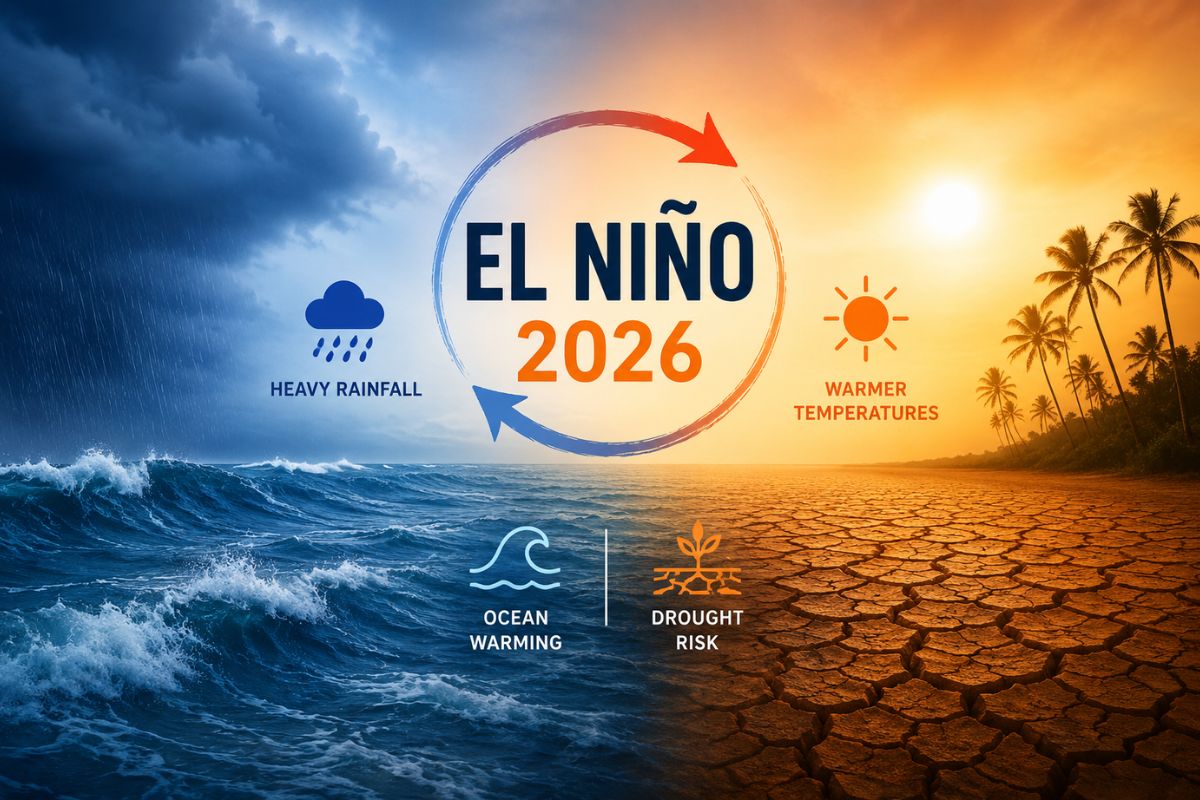
Summary: The World Meteorological Organization (WMO) and UN officials are sounding urgent alarm that a moderate-to-strong El Niño is likely by mid-2026, raising the risk of record global temperatures and extreme weather.
Forecasts from WMO, NOAA and ECMWF agree El Niño will arrive by summer 2026 and persist into late 2026, but its eventual strength is uncertain. Experts caution that even a “moderate” El Niño on top of the unprecedented heat baseline could trigger severe heatwaves, droughts, floods and coral bleaching worldwide.
The WMO’s June 2026 outlook says warm Pacific Ocean waters have pushed El Niño conditions to “90% certainty,” with an 80% chance it forms by June–August and ~90% chance it lasts through November. WMO chief Celeste Saulo warned: “We need to prepare for a potentially strong El Niño event – which will exacerbate drought and heavy rainfall and increase the risk of heatwaves both on land and in the ocean”.
UN Secretary-General António Guterres echoed this urgency, calling El Niño “an urgent climate warning” that will “pour fuel on the fire of a warming world”. In 2024, a strong El Niño helped make it the hottest year on record, and officials fear 2026–27 could challenge that mark.
El Niño Forecasts and Probabilities
All major forecasting centers now agree El Niño is coming. NOAA’s Climate Prediction Center (CPC) in May 2026 placed El Niño Watch at 82% probability for May–July and 96% for Dec 2026–Feb 2027. The WMO/IRI model consensus similarly pegs ~80% odds of El Niño by summer and ~90% chance into late 2026.
NASA/ECMWF seasonal models show Pacific sea-surface anomalies could reach well above +1.5°C (the “strong” threshold). One analysis found ensemble forecasts in April 2026 spanned a wide range (0.2°C to 3.3°C in Niño-3.4 anomalies) but with a large majority of models projecting warming above +1°C by autumn.
University of Albany climatologist Paul Roundy, summarizing ECMWF data, noted “confidence is clearly shifting higher on potentially the biggest El Niño event since the 1870s”.
Recent Global Temperatures and Historical Context
Even without a new El Niño, recent years have been exceptionally warm. According to NOAA, 2024 was the warmest year on record (≈1.46°C above pre-industrial); 2023 and 2025 also rank among the top three. Berkeley Earth finds 2025 was the third-warmest year (≈1.44°C above pre-industrial), slightly cooler than 2024 and 2023.
The past decade contains all 10 of the hottest years on record. Warming trends (≈0.2°C/decade since 1980s) mean that every El Niño now starts from a higher baseline than past events.
Past El Niño comparisons: Strong El Niño events often leave a lasting imprint. The 1997–98 “super” El Niño helped push 1998 to record warmth, and the strong 2015–16 El Niño broke global temperature records again.
The 2023–24 El Niño, deemed “strong,” made 2024 the hottest year on record. Scientists note that a “moderately strong” El Niño in 2026–27 could drive global annual averages toward 1.7°C above pre-industrial levels, flirting with the 1.5°C guardrail. (James Hansen et al. project a 2027 peak around +1.7°C.)
However, each El Niño is unique. As WMO stresses, climate change is not proven to make El Niños more frequent, but it “amplifies” their impacts by adding heat and moisture to the system. WMO notes 2024 was hottest not just due to El Niño, but “because of the combination of the powerful 2023–2024 El Niño and human-induced climate change”. In short, natural variability is on top of a steadily warming climate.
Impacts: Heat, Drought, Floods, Coral Bleaching
A renewed El Niño could exacerbate already worrying climate extremes. El Niño typically brings heatwaves to many regions – often far from the Pacific – and disrupts rainfall patterns. For example, higher rainfall often hits southern South America, the southern U.S., the Horn of Africa and parts of central Asia, while drought tends to strike Australia, Indonesia, Central America and South Asia.
WMO specifically warns this shift “increases the risk of heatwaves both on land and in the ocean.” (Warmer seas threaten coral reefs and amplify marine heatwaves.)
Recent events show the stakes. In April–May 2024, unusually heavy rains – fueled by El Niño and background warming – caused massive flooding in Brazil’s Rio Grande do Sul, killing over 180 and displacing hundreds of thousands. Francisco Aquino of Brazil’s climate institute warned a similarly strong El Niño in 2026 could repeat that devastation.
In southern Africa, an El Niño drought may strain water and food: Izidine Pinto of the Netherlands Meteorological Institute notes that climate change makes the below-normal rainfall “last longer or have less rainfall… affecting agriculture” in already vulnerable farming regions.
Elsewhere, scientists expect intense tropical cyclones in the Pacific (warmer waters favor storms) and generally more volatile weather worldwide. The long-term concern is that a big El Niño could serve as a harbinger of future climate extremes that may become commonplace as warming proceeds.
Expert Commentary
Climate scientists stress urgency. Piers Forster (Professor of Physical Climate Change, University of Leeds) emphasized that El Niño will “intensify storms, heatwaves, droughts and the resulting disasters” on top of today’s record baseline.
He noted bluntly, “When we get an El Niño… these things become more intensified and more impactful”. Francisco Aquino (director of the Climate Center, Rio Grande do Sul) warned that a strong El Niño would present “the exact same scenario we saw” in Brazil’s floods, since “the world keeps getting warmer, and the temperature in the ocean keeps rising.”. Izidine Pinto (KMNI Senior Researcher) likewise warned of lengthened drought in southern Africa under climate change.
James Hansen (Columbia University, former NASA) has projected that a 2026–27 El Niño “could lock in” a global mean near 1.7°C, making future cooling below 1.5°C unlikely. Meanwhile, researchers in Seoul (Jong-Seong Kug et al., Nature Comm. Dec 2025) have proposed the concept of “climate regime shifts” triggered by very strong El Niños, noting that only three “super El Niños” (1982–83, 1997–98, 2015–16) have been documented, each causing profound and lasting changes to weather patterns and ecosystems. These voices underscore that while El Niño is natural, its impacts on a human-warmed planet could be severe.
Sources: UN and WMO statements (June 2026); Reuters news reports (June 2026); NOAA/CPC ENSO updates (May 2026); ECMWF seasonal analysis; climate data from NOAA and Berkeley Earth; expert quotes from academic sources.




GIPHY App Key not set. Please check settings