
 Brown Walsh
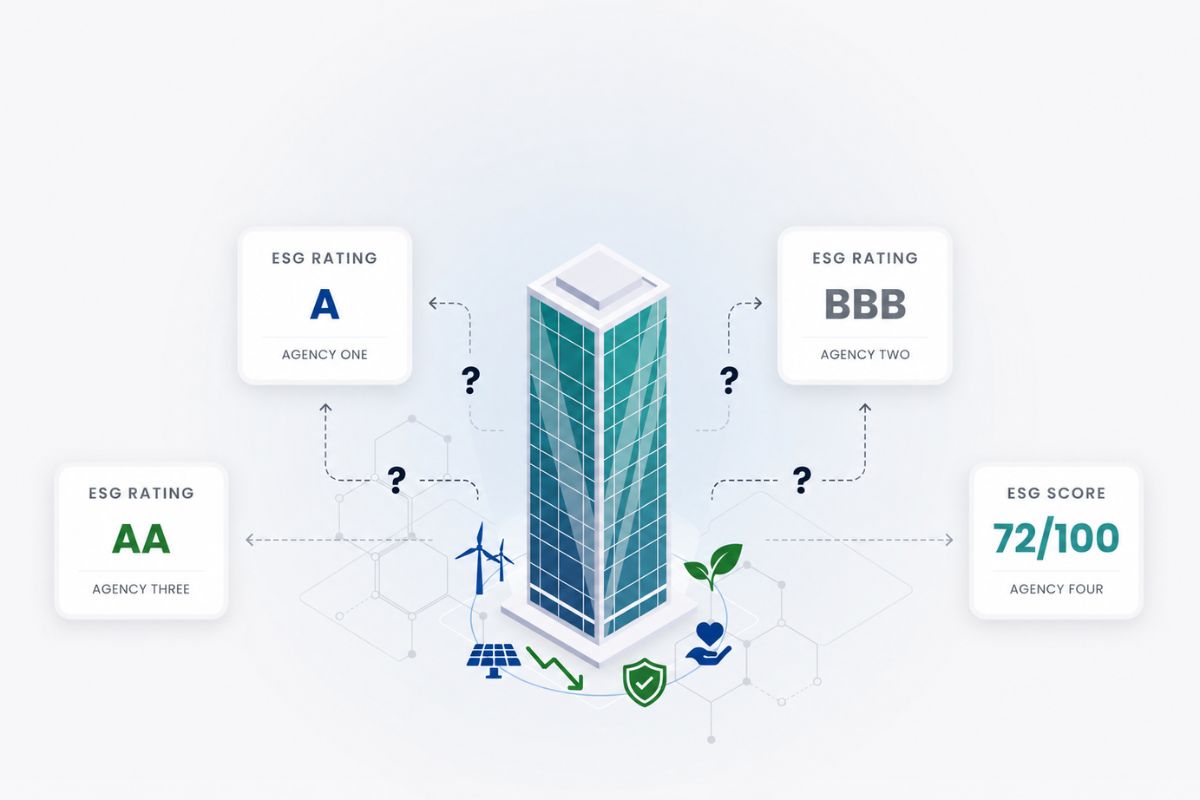
A company receives a strong ESG score from one ESG ratings provider and a weak score from another. It creates a credibility problem for investors: which rating should they trust? The usual explanation is that providers use different methodologies, which is true, but incomplete.
The disagreement often begins at the early stages, with the information each provider collects, accepts, estimates, and leaves out. Two ESG rating agencies may appear to assess the same company, but in practice, they may be working with different versions of its ESG record.
An ESG Rating Is a Score Built on Evidence—And That’s Why It Isn’t Consistent across Different Scoring Agencies
An ESG rating is a score given to a company by an independent rating agency (like MSCI, Sustainalytics, or S&P Global) that measures how well the business manages risks and opportunities related to Environmental, Social, and Governance factors. In short, it is a conclusion drawn from selected evidence, such as.
- Which ESG issues are material
- Which sources are acceptable
- What to do when a value is missing
- Whether policies, actions or outcomes matter most
The gap between two agencies’ ESG ratings isn’t always a debate about how “good” or “bad” the company is performing but about how the rating agencies treated the evidence around the company differently.
Here’s why ESG scores from leading rating agencies can differ for a single target organization.
The Underlying Data May Be Different
Most ESG rating agencies review regulatory filings and corporate websites. Beyond that common base, their inputs can separate quickly.
- One rating provider may review court records, enforcement notices, local media, and NGO reports. Another may rely more heavily on company submissions and commercial databases.
- One may capture an incident within days or in real-time, while another may be dependent on annual disclosures and may not consider the new information until its next review cycle.
- Scope varies too. A provider may include subsidiaries, suppliers, or overseas operations while another may limit their research to parent company operations only.
This is a major cause of divergence in ESG ratings. The agencies are not always looking at the same facts differently. Mostly, they are working from different sets of facts altogether.
Missing Data Creates Different Answers
Corporate ESG disclosure data remains incomplete in areas such as Scope 3 emissions, supplier labor conditions and workforce outcomes. When data is missing, an ESG rating provider may
- Penalize non-disclosure, assuming “no data = hiding something bad”
- Estimate the value using peer data, industry averages, or AI models or apply a sector proxy
- Carry forward an older figure the company did publish and assume nothing has changed
- Remove the metric and rescale the rest of the company’s score
Each option can change the score. A precise-looking rating may contain calculated values. And, how they calculate the value will differ for each rating agency’s algorithm. This is an ESG data quality issue that affects consistent scores.
The Same Evidence Can Tell Different Stories
Even when ESG rating providers use the same source for ESG data or same ESG research methods, they may measure different aspects of performance. Consider workplace safety:
- One provider may score the presence of a safety policy (measures intent)
- Another may assess injury frequency (examines results)
- A third provider may examine fatalities and enforcement action (adds controversy and severity)
Neither agency has necessarily made a factual error; they are just measuring different things. It is natural then that the final ratings will not be the same for that business.
Policies are Subjective and Naturally Lead to Conflicting Ratings
Rating agencies look at company behavior by separating it into three categories:
- Policies (Intent): Having a written rule (e.g., “We have an anti-discrimination policy.”). This proves a system exists on paper, but it doesn’t prove anyone actually follows it.
- Activities (Effort): Taking an action (e.g., “We hosted 5 diversity workshops.”). This shows the company is trying, but proves nothing.
- Outcomes (Results): Showing actual proof. (e.g., “Our gender pay gap reduced by 12%.”).
The OECD’s 2025 Behind ESG ratings report, which examined more than 2,000 metrics used by major ESG rating products, found that only about 30% measure actual outcomes such as emissions or pay gaps — roughly 68% capture self-reported policies and activities instead. Most of what an ESG score rests on is intent and process rather than results, and self-reported process data is exactly the kind of input two providers can collect, interpret, and verify differently.
Why Rating Disagreement Matters?
If you only look at one ESG score (like, a 90/100), you might think, “Great, this company is definitely sustainable.” But if you look at three different ratings for the same company and see a 90, a 40, and a 65, you realize nobody actually knows for sure.
The FCA’s December 2025 research found that half of surveyed users questioned underlying ESG data quality. Naturally, if MSCI rates Company X as “AAA” (eligible) but Sustainalytics rates it as “High Risk” (ineligible), fund managers don’t know whether they can legally or ethically buy the stock. Conflicting ratings can affect investment eligibility, issuer rankings and regulatory exposure.
ESG Data Verification Can Change the Picture, Making Ratings More Reliable and Trustworthy
A sustainability rating is not automatically defensible. Definitions may change, boundaries may shift, and figures may lack independent assurance. Independent ESG data verification (in which a third party checks the data source, reporting period, unit, boundary, and calculation basis) ensures the accuracy of the facts. ESG rating agencies don’t have to guess missing values or model estimates.
Upcoming Regulations Will Only Improve Transparency
The EU ESG Ratings Regulation is applicable from 2 July 2026 and requires greater transparency around methodologies, assumptions, estimates and data limitations. The proposed UK regime (expected to be implemented in June 2028) also focuses on transparency, governance and reliable processes.
Basically, agencies will now need to publish:
- Exactly where they got their data.
- Which numbers were estimated vs. verified.
- What assumptions and limitations affected the final score.
These regulations will make sure that there is no guessing, fake accuracy, or secret data manipulation in ESG ratings. Agencies will still be allowed to use different bases for their scores, but investors will be able to see why they disagree.
End Note
The purpose of ESG data research is not to force two ratings into agreement. It is to establish what each provider knows, assumes and overlooks.
That requires disciplined ESG data collection, structured data management and reconciliation across conflicting records. For portfolios with broad issuer coverage, specialized ESG data research services can support this work without replacing the investor’s materiality judgment.
This post was created with our nice and easy submission form. Create your post!





GIPHY App Key not set. Please check settings